Choosing Backwoods and or Hunting Knives
I have noted that very little support or direction is given to choosing knives, perhaps because of the male ego or the I know all about knives macho complex. Maybe in some small way I can remedy that in at least a few areas.
When either you succumb or choose to go out into the woods and or the wilds and decide you will have a sheaf knife.
Handle the knives and handle as many as possible don't just go to one shop and don't buy online.
The knife needs to feel comfortable in your hand and you do not feel as if it is hard work or any effort to grasp, never buy a knife that makes you feel a strain to clasp in your hand nor one which you feel will tire your hand if used for several hours constantly. A knife needs to feel like an extension of your hand if you cook a fair bit you will know how large the handle needs to be and that is needs to be comfortable as you will almost certainly have developed a preference to a particular kitchen/cooking working knife which you feel at home with. The same applies in the wilds perhaps even more so.
An outdoors persons knife will tend to have a thicker blade the cook’s knives that you may be used to. The handle must have a full tang that is to say the material the blade is made of needs to be the full width of the handle. Look for handles that are both non slippery if they get mucky with any meat or intestines of any game you are butchering and feel comfortable to hold. I personally favour stags horn handles as I have used knives made of every other material but never found one as successful and perfect for grip when covered with muck. Unlike when at home in the kitchen you cannot keep going and rinsing the muck off your hands. Sure you can wipe the worst off on any grass but if you do that too much you just end up sitting in the middle of a messy and mucky area and that will only attract insects and if the weather is warm it will soon get fairly smelly.
As I have previously said the blade will be thicker that a normal kitchen knife and as a consequence it will be heavier. Please do not however fall into the trap that so many men fall into - Knives are a cutting tool meant for cutting and slicing they are not meant for chopping. If you want to chop or cut thick timber buy an axe ( the Gransfor Bruks - small forest axe is as good as you can get). In the jungle a machete is the tool to have and if you are in very heavy undergrowth of a high bracken or bramble area then they are fine in wilds in Britain. Nor do you need a knife for fighting i.e. the original Bowie knife was basically a short sword designed as a very heavy backwoods knife crossed with the need for a fighting weapon.
The blades on most Hunting, Camping, Backwoods, Outdoors knives in most of the shops will tend towards a useless macho image of Rambo the survivor and quite a lot will have a saw back leave these alone as 90% are useless and you are unlikely to need a saw backed knife. If you want a saw buy a Bahco Laplander folding wood saw a most excellent saw for the woods and the wilds the saw blade locks in position.
However just forward of the guard – that is the cross part between the blade and the handle sometimes the part near the blades sharpened edge is called the front quillon. Is on the sharpened side of the blade a short area of serrated blade this is intended for cutting sinews in game, when butchering fresh caught game. Unless you are planning of butchering a fair bit of game like deer for instance or wild boar you are unlikely to need this part serrated.
As for knife shapes I personally prefer either what is called a drop point or straight back or a spear point. But check for blade shapes and or names on line while keeping in mind what you are going to use it for. Please bear in mind sometimes you will need a slightly pointed blade tip but it does not have to be needle tipped so a gentle point will serve you well.
Materials a good all round material is 440c or 440hc this is a carbon stainless steel or a high carbon stainless steel. Fairly resistant to rust and stains while still maintaining the properties needed to take a good cutting edge and retain it. You will come across references to hardness often described as anything from 54 to 63 this is a test of hardness of the material under the Rockwell testing system. However choose one between 57 and 59 as you will find below this it is too soft and will take a great edge but will need constant re-sharpening above 59 and the blade becomes too hard and increasingly brittle which you will find are very hard to sharpen.
Sharpening in the field I personally prefer to use a WHITE ARKANSAS STONE with water, I have tried many of the new style diamond sharpening rods and stones but always have switched back to my white Arkansas.
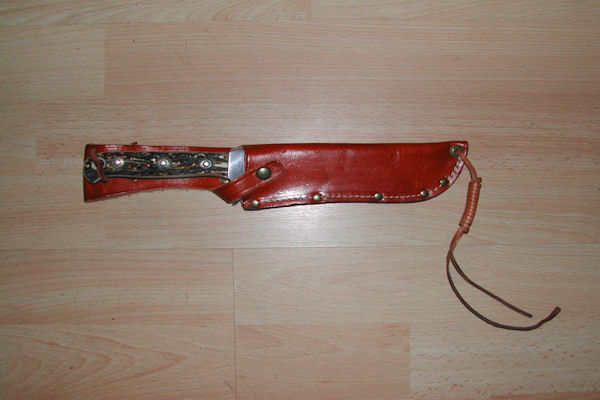 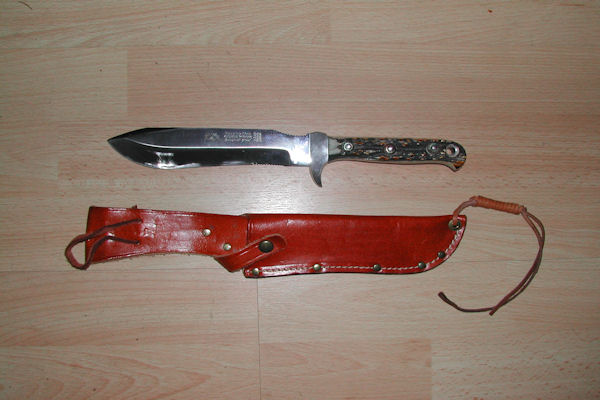 The Knife is a Carl Schlieper Trophy Line Guide knife made from Surgical Steel, Similar too the Puma White Hunter but thicker and made of different steel. The angled edge at the tip is a sharpened chopping edge. | 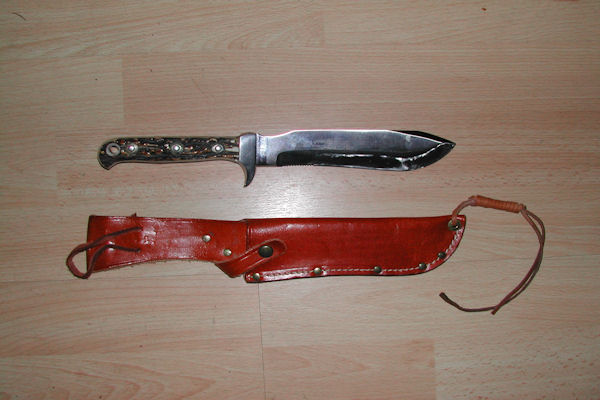 The extra thong which you can see threads through the handle is because I often wear a knife upside down on a chest rig or in adapted jackets, vests and rucksack shoulder straps. I also use this additional method of securing knives on belts, thigh sheaf's and calf sheaf's. This particular sheaf is my storage sheaf as whenever I have been out on my return I clean and sharpen my knives. The blade is short being just over six inches. |
